
How SMEs Can Safeguard Against AI Risks with Simple Policies and Forward-Thinking MSP Services
Artificial intelligence (AI) tools are becoming common in workplaces of all sizes. Small and medium-sized enterprises (SMEs) often adopt these tools quickly to boost productivity and innovation. Yet, the National Cyber Security Centre (NCSC) recently issued a warning about the risks when staff use AI without proper oversight or clear policies. This gap can expose businesses to data leaks, compliance issues, and security threats.
The good news is SMEs do not need complex technical setups to protect themselves. Simple policies combined with managed service provider (MSP) support can create strong safeguards. MSPs also position SMEs as forward-thinking by helping them use AI safely and effectively.
This post explains what risks SMEs face with AI, practical policies to reduce those risks, and how MSP services can help manage AI security without deep technical knowledge.
Understanding the Risks of Unsupervised AI Use in SMEs
AI tools like chatbots, content generators, and data analyzers often require employees to input sensitive or proprietary information. Without clear rules, staff might:
Share confidential data with AI platforms that store or process information externally
Use AI-generated content without verifying accuracy or compliance
Expose the business to phishing or social engineering attacks through AI misuse
Create inconsistent or unapproved outputs that damage brand reputation
For example, an employee might paste customer details into a public AI chatbot to get quick answers. If the chatbot provider stores this data, it could lead to a breach of privacy regulations like GDPR. Another risk is relying on AI to generate legal or financial documents without expert review, which can cause costly errors.
These risks are not hypothetical. The NCSC highlights that many SMEs lack simple policies to guide AI use, leaving them vulnerable.
Simple Policies SMEs Can Put in Place Today
SMEs can reduce AI risks significantly by adopting straightforward policies that everyone understands and follows. Here are key policies to consider:
1. Define What AI Tools Are Approved
Create a list of AI tools that employees are allowed to use for work purposes. This helps control where data goes and ensures tools meet security standards.
2. Set Clear Rules on Data Sharing
Specify what types of data can be entered into AI tools. For example, prohibit sharing personal customer information, passwords, or confidential business plans.
3. Require Verification of AI Outputs
Employees should verify AI-generated content, especially for legal, financial, or customer-facing materials. This prevents errors and misinformation.
4. Train Staff on AI Risks and Best Practices
Regular training sessions help employees understand potential dangers and how to use AI responsibly.
5. Monitor AI Usage and Review Policies Regularly
Assign someone to oversee AI use and update policies as new tools or threats emerge.
How MSP Services Support SMEs in Managing AI Security
Managed service providers offer expertise and resources that SMEs often lack internally. MSPs can:
Assess AI risks specific to the business and recommend tailored policies
Implement monitoring tools to track AI tool usage and flag unusual activity
Provide staff training on AI security and compliance
Manage vendor relationships to ensure AI tools meet security requirements
Offer ongoing support to adapt policies as AI technology evolves
By partnering with an MSP, SMEs gain a trusted advisor who understands both technology and business needs. This partnership helps SMEs stay ahead of risks without needing deep technical knowledge.
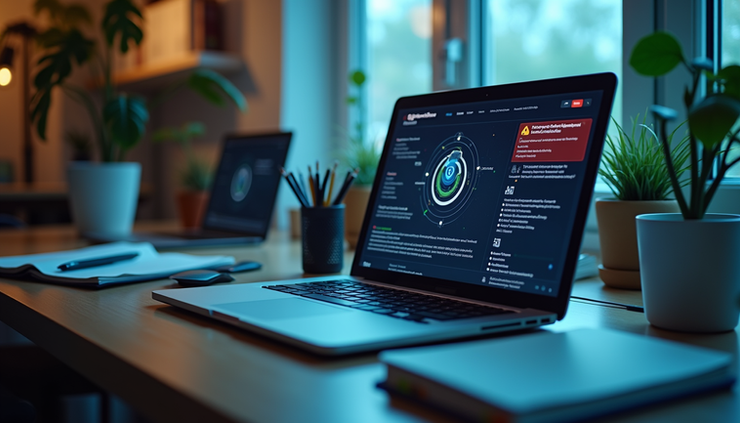
Small office workspace showing AI security alerts on laptop screen
Practical Steps for SMEs to Start Protecting AI Use
Here are actionable steps SMEs can take immediately:
Inventory current AI tools used by staff and evaluate their security features
Draft a simple AI use policy covering approved tools, data sharing rules, and verification steps
Communicate the policy clearly to all employees and make it easy to access
Schedule regular training sessions to keep awareness high
Engage an MSP to review policies, provide training, and monitor AI use
For example, a local marketing agency worked with an MSP to create a policy that banned sharing client names or financial details with AI chatbots. The MSP also set up alerts for unusual AI activity and held quarterly training. This approach reduced data risks and improved staff confidence in using AI tools.
Why Forward-Thinking SMEs Choose MSPs for AI Security
MSPs help SMEs not only protect themselves but also position their business as responsible and modern. This can be a competitive advantage when dealing with clients or partners who care about data security.
MSPs bring:
Experience with multiple industries to understand unique AI risks
Access to security tools and expertise that SMEs cannot afford alone
Proactive updates on emerging AI threats and best practices
Peace of mind so business owners can focus on growth instead of worrying about AI risks
Choosing an MSP is a practical step for SMEs to keep pace with AI technology safely.
Final Thoughts on Managing AI Risks in SMEs
AI tools offer great benefits but come with risks that SMEs must address. The NCSC’s warning highlights the need for simple, clear policies and oversight. SMEs do not need to be tech experts to protect themselves. By adopting straightforward rules and partnering with MSPs, they can use AI confidently and securely.
Start by defining approved AI tools, setting data sharing limits, training staff, and monitoring use. Then, work with an MSP to strengthen your approach and stay updated on new risks.
Taking these steps today helps SMEs avoid costly mistakes and shows clients and partners that the business values security and responsible AI use.
Disclaimer: This post provides general information on AI security policies and managed services. It does not constitute legal or professional advice. SMEs should consult qualified experts for specific guidance.


